Skip to product information
1 of 5

Midicake

Midicake ARP

Midicake ARP

Regular price £449.00 GBP
Regular price Sale price £449.00 GBP
Sale Sold out
Taxes, duties and delivery included. Nothing further to pay on arrival.
Colour
Quantity

ARP V9 launch offer

Subscribers pay £429.00 GBP until 15 December. Sign up below for your code.

Ships by the end of November.

Expected Shipping - November 2026. 

A 4-track hardware MIDI arpeggiator and sequencer for creative and generative music composition. Four polyphonic channels with real-time control — for hobbyists, musicians, and composers building complex musical patterns. Angle stand included.

  • Layer and Follow workflows
  • Sequence and Rhythm Editors
  • Per-channel modulators for parameters and MIDI CC
  • Editable chord/scale engine and chord sequencer
  • Incoming note and chord sync
  • MIDI CC control, internal/external clock sync
  • Mono and Poly synth modes, programmable macros
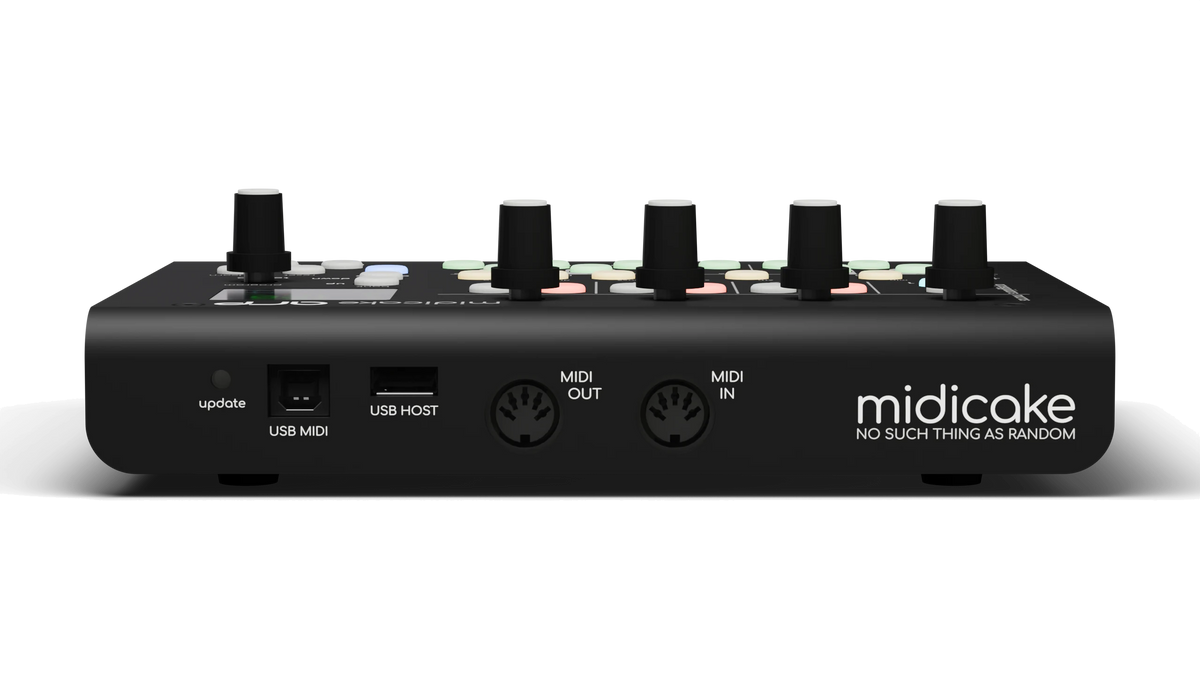
  • MIDI DIN In/Out + Thru, USB MIDI, USB Host
  • 5V USB powered, VESA mounting points

Play-Mode gives direct musical control through key and chord selection; Set-Mode configures channels independently or grouped, in real time. Controls up to 8 devices at once.

Free firmware updates for life — ARP is on its 9th generation and counting.

View full details

Questions

What is Midicake ARP?

Midicake ARP is a four-channel MIDI arpeggiator that takes a parametric approach to generating musical sequences. It integrates and synchronises with your other MIDI controllers and instruments to make new and exciting music.

Can each channel play a different synth?

Yes. ARP has four arpeggiators, and each can output on its own MIDI channel.

Can ARP receive clock?

Yes, over 5-pin DIN MIDI, USB MIDI or the USB host port.

Does ARP support CV?

No. ARP is mainly a polyphonic device, and its multi-channel and layering features would need a lot of CV ports. It's also powered over USB at 5V, which isn't enough to power a 12V CV rack.

However, each arpeggiator has a Mono voice mode, so with an external MIDI-to-CV converter it works easily with CV-only gear.

Does ARP do swing?

Yes, through Groove patterns. Pick a two-step pattern with the second step delayed and you have the classic swing feel; the default patterns make this easy. Each pattern has up to 16 steps, so you can build much more complex grooves too.

For finer control, add a two-step pattern to the Delay parameter.

What is the maximum sequence length?

ARP isn't a traditional step sequencer: its arpeggios are driven by parameters.

The sequence length depends on the parameter values and how they interact. In a bar of 96 MIDI clock ticks, the Time parameter sets how many steps play per bar. The Steps and Repeat parameters then set how many steps play before the sequence repeats.

Add modulation, rhythm patterns and effects and a sequence might not repeat for a very long time, which takes you into generative composition.

It doesn't take long to learn how each parameter shapes the sequence. Then you can explore the huge range of results you get by combining them.

Does ARP work like a classic synth arpeggiator?

Yes and no.

ARP is parametric: every note it plays in a sequence is driven by a set of parameter values. A classic arpeggiator uses the notes you hold (and sometimes the order you played them) to build the sequence.

ARP uses the notes you play to set the scale its sequences play in. That means:

  • You don't need to be Mozart to get complex, great-sounding melodies.
  • Every sequence is deterministic, so it always behaves the same way.

The rhythms, themes and feel you create with the parameters stay the same whatever notes you play on the keyboard. It's pretty cool.

Why is there no such thing as random?

“A deterministic system is one in which no randomness is involved in the development of future states of the system. It will always produce the same output from a given set of inputs.”

We chose not to rely on random generators, which plenty of other controllers already do. The patterns ARP creates are deterministic and repeatable: not random, just complex.

You can still get pseudo-random effects by applying FX modulation to any of ARP's parameters.

Does ARP support modulation?

Each arpeggiator has two independent modulators that can change any parameter over time.

Each one also has an FX setting, which works like a modulator but uses a seeded sequence to generate repeating patterns of values that change a parameter on every step. Together they let you program how a sequence evolves over time, with some amazing results.

What are ARP's dimensions?

  • Dimensions: 205 × 150 × 58 mm (8.1 × 5.9 × 2.3 in)
  • Weight: 1.2 kg (2.65 lb)

Does ARP have mounting points?

Yes. There are 100 mm VESA mounting points on the underside; use M4 machine screws, 10 to 15 mm long.

ARP isn't designed for rack mounting, but you could make adapter plates.

Can ARP arpeggiate a synth live?

Yes. ARP generates an arpeggiated sequence when you press notes on a connected MIDI keyboard.

Or press Play and use your keyboard to change the scale that's playing.

Does the price include VAT and import duties?

Yes, in the UK, the EU, the US, Canada, Switzerland and Australia. The price you see is the price you pay: VAT, import duties and delivery of an instrument are all included, and there's nothing further to pay on arrival.

Everywhere else, your order ships from the UK in GBP without UK VAT. Your local customs may charge import duty and tax, which DHL collects before delivery.

How long does delivery take?

We ship from South Wales with DHL, tracked. Most orders arrive the next working day in the UK and in about three working days in Europe and North America. Allow 3 to 5 working days to be safe.

Pre-orders ship in the dispatch window shown on the product page.

Delivery times are in DHL's hands, so we can't guarantee them, but if anything goes wrong we'll chase DHL for you and sort it out as quickly as we can.

All FAQs